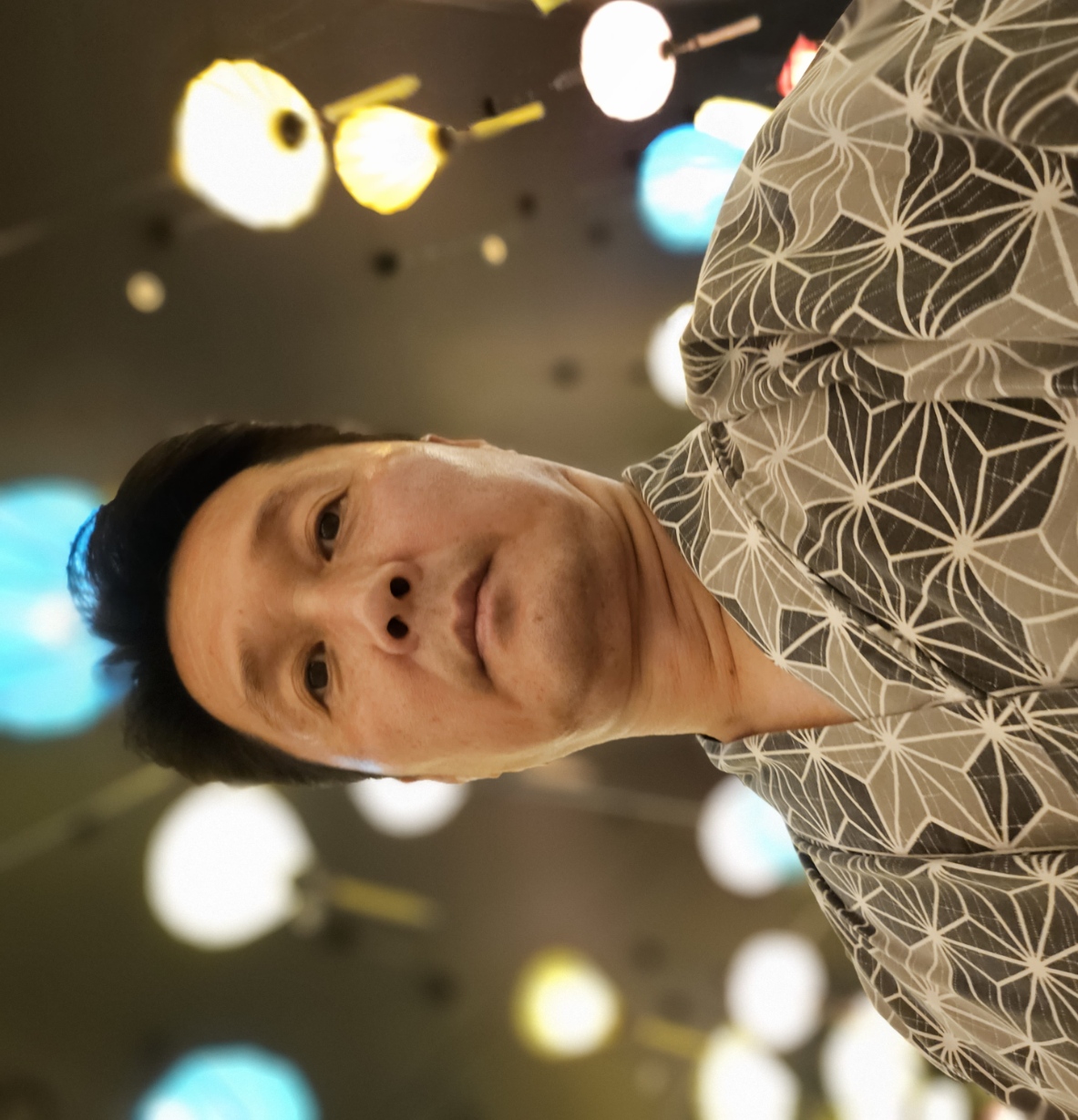
About Nim
Personal Story
The true me never changes, and it is not me that changes.
So there is only one unchanging principle in the world, and that is that it 'changes'.
The most important point here is not that it 'changes', it is that it is the 'only principle' and that is our unchanging nature, which is enlightenment.
Our bodies and our lives change over time, and we think we've accomplished something with them, and we live our lives believing that our bodies are us until the end of our lives, and then one day our bodies reach the end of their lifespan and we die, and then we die with them.
It reminds me of the foolishness of the king of a country who mistook his body for the only thing he had, and when he died, he wanted to bury his many subjects and possessions in his tomb so that he could enjoy eternal life.
In our normal lives, where we firmly believe that our bodies are us, we want to know the history of each other's bodies, like when we buy salami at the supermarket, we want to know the date it was made, etc.
If you ask me what my true nature is, I'll hold up a finger, and if you ask me again, I'll say "this" out loud.
This is to show you that my nature and yours are not different, as pouring water on water to be came one instead of two, so that the answer to your question is one.
Nevertheless, if you are interested in my body and its history, I will give you a brief introduction.
I don't know exactly why I came across this body or what motivated me to manufacture it, but I do know that the country of manufacture is Seoul, South Korea, and the year of manufacture is 1970, which I was told by my parents.
I don't remember exactly how I first learned about the use of this body.
However, just like when we first encountered a car, I gradually got used to it over time, and as it was upgraded, I gradually developed precise senses such as navigation, and dreamed of the future, and the functions of the body got better and better, so by the time I was 18 years old, I became a movie star according to the flow of life, and I studied abroad in Japan and had the experience and thought that the world was wide.
But at a certain point in my life, I realized that I was attached to this body, which is not the real me, although I keep it close to me and use it according to my connections, like my house, my car, and I don't even know where it came from or where it's going, and I started to doubt the things that I thought were me all my life, so I went on the path of Seon (Zen) study to find the real me.
In order to follow in the footsteps of the founder of Zen (Dharma Master), I traveled to Shaolin Temple in China in the winter of 1994, where I met many monks and friends, but never met my true teacher, and spent many hours in zazen at the place where the Bodih Dharma was staying.
Then I met Rainer Deyhel from Germany in Shaolin and we became sworn brothers, and he opened the German Shaolin Temple in Berlin in the early 2000s, and I was teaching zazen to people in there and living as a 'Zen Master without enlightenment', but one-day the German Shaolin Temple, which had a European license, learned the expensive lesson that 'Buddhism without enlightenment is not Buddhism' and eventually closed its doors, and we both left Germany for Cambodia, leaving all memories behind.
I practiced for a long time, as most practitioners do, in a vague and complacent way, thinking that one day I would realize, but I never resolved the question of 'who am I' and wandered around Hong Kong, Thailand, Cambodia, and other countries as fate would have it, before returning to Korea permanently around 2014.
In the winter of 2015, he stumbled upon a book by an ordinary 90-year-old Korean man called 'Even the Buddha Can't Go There', which became the catalyst for the enlightenment, and I spent the next six months listening to his teachings day and night, even in my sleep, without removing my earphones.
Then one day, the experience of everything crashing down around me, including myself, with the very ordinary and mundane sound of wood knocking outside my house is a 'moment' that cannot be measured in time, but it clarified the nature of not only me, but of everything in the world, and all the questions that had been bothering me were extinguished in a single moment.
With the help of the Korean Seon (Zen) masters who guided me through that liberating experience, I became even clearer and have been living a life of sharing and validating valuable experiences with those who connect with me ever since.
I would say that the Buddha's enlightenment, or the enlightenment of any great man, is only another person's experience, so don't be fooled by stories, and verify it for yourself.
In the end, all I am talking about is 'this' and nothing else.
The Name
Before you were born
In Korea, Seon's meaning of teacher is greater than that of a parent, so calling someone a teacher and following them is something to be taken with a grain of salt.
In my Dharma talks, I refer to my teacher as 'Nim' instead of calling him/her by name, which is a basic courtesy in both the East and West.
The bigger reason is that the Korean word 'nim' has many different meanings.
In Korea, 'nim' has the same meaning as 'Dear' in English, and is used to address God, saints like Buddha, Jesus, or anyone else you respect, and it can also be used after any pronoun in the world as a sign of respect, but it is rarely used in colloquial speech because its meaning is uncertain when used alone.
As explained above, it is rarely used in isolation, but in "The Silence of Nim" by Korean Seon monk and poet Man Hae, he describes it as a loved one whom he misses dearly, but whose true meaning is someone he should meet but cannot.
Whenever you address me as 'Nim', you are not calling me, you are calling your true self, and one day, when the whole of you answers that fervent call, you will prove to yourself the enlightenment of all Buddhas and Seon Masters.
In that sense, Nim is only a mirror reflecting you, a finger pointing to the moon.
The Title
To those who have no interest in the path of practice, a Zen master who abruptly cuts off conversation or utters incomprehensible sounds may simply appear to be a stubborn and authoritarian old man.
However, the true authority of a teacher in the Zen tradition does not stem from status or power. I will explain where this authority comes from in the world of Zen, which pursues "emptiness," and what the relationship between such a stern teacher and his disciple entails.
-
The Source of True Authority: Honesty Derived from "Emptiness"
While worldly authority typically stems from "what one possesses" (position, knowledge, wealth), a Zen master's authority stems from "what one has emptied."
Natural Gravitas: A Zen master does not seek to lord over his disciples. Rather, he simply becomes an empty mirror, reflecting the disciple's foolishness exactly as it is. A person who has completely let go of the ego exudes a cool, serene aura without any pretense. This is not something forced; it is a presence that naturally emanates from a life united with the Truth (Emptiness).
The Authority of Non-Duality: The teacher does not view the disciple as "someone to be taught." The teacher and the disciple are inherently one. The master's authority is not meant to suppress the disciple, but is merely a "sword of expedient means" borrowed temporarily to awaken the Buddha sleeping within the disciple. -
The Meaning of "Zen Authority" Between Teacher and Disciple
In Zen, the relationship between teacher and disciple is on a different level from the worldly relationships of "superior and subordinate" or "teacher and student."
First, the "Sword of Killing" and the "Sword of Life"
A Zen master's authority is sometimes frightening and chilling. This is because the master mercilessly cuts away the "sense of self" (ego) that the disciple cherishes so dearly. Killing the disciple's preconceptions is the sword of death, but reviving true life through that death is the sword of life. The reason the disciple bows before the master's authority is because they believe that this fearsome blade will ultimately set them free.
Second, the Art of "Chul-tak Dong-si" (Pecking and Cracking Simultaneously)
When a chick pecks at the shell from the inside, it is called "chul," and when the mother bird cracks the shell from the outside, it is called "tak." A master's authority is not a power to be wielded at will. It is a compassionate timing seizing that fleeting moment when the disciple's quest for enlightenment reaches its limit to crack open the shell. Through the master's authority, the disciple realizes their own limitations, and through the disciple's earnestness, the master transmits their teachings. Here, the master's authority is not "domination" but a necessary condition for "fulfillment."
Third, the non-attachment of "the pine tree in the courtyard"
A true master does not wish for the disciple to worship him. Rather, he hopes the disciple will step over him and move beyond. "If you meet the Buddha, kill the Buddha; if you meet the Patriarch, kill the Patriarch (Sallbul Salljo, 殺佛殺祖)." This is the highest teaching of the Zen school. When a disciple tries to rely on the master, the master instead uses the sword of authority to cut away that very point of reliance. To enable the disciple to stand tall on their own—that is the ultimate purpose of Zen authority. -
In summary
The authority of a Zen master is the "weight of emptiness." While worldly authority says, "Follow me," the authority of Zen commands, "Look within yourself." It may appear overbearing to those with no interest in enlightenment, but to the seeker striving to resolve the problem of life and death, that authority is like the only lighthouse encountered in the pitch-black night sea.
Therefore, it is a very common occurrence in Buddhist history that people who pretended to be true Buddhists, lived in Buddhist temples, and used or sought to use the authority they had accidentally acquired for their own selfish ambitions have slandered true masters.